Spoiler note: this post covers story changes in episodes 1 through 4 of Dragon Ball Super: Beerus. If you know Battle of Gods, it spoils the edits rather than the plot.
Four episodes in, Dragon Ball Super: Beerus has reached the moment the 2015 anime needed nine episodes to reach. Goku's Super Saiyan God transformation landed in episode 4 on November 1, and that speed is the whole story of this remake. Everything worth arguing about, from the rebuilt King Kai fight to Vegeta's missing cooking scene, is a side effect of that compression.
So instead of another episode recap, we did what a remake invites: we lined the changes up and graded them. Below is where the show stands as of November 3, 2026, the math on where it is heading, and the ten biggest changes from the original, ranked best to worst.
Where Things Stand on November 3
The series premiered on time, October 11 at 11:15 PM on Fuji TV, and four episodes have aired since: "The God Who Destroys" (October 11), "The God of Destruction Heads to King Kai's Planet" (October 18), "The God of Destruction Heads to Earth" (October 25), and "The God of the Saiyans" (November 1). Kanzenshuu's episode guide lists episode 5, "The God of Destruction and Son Goku," for November 8. Anime News Network's weekly charts, which estimate Kanto household viewing, put the first three episodes at 2.8%, 2.8%, and 2.9%, so the audience did not fall away after the premiere.
In the US, you have three options. Crunchyroll carries it in Japanese with English subtitles, with Kanzenshuu reporting episodes post roughly an hour after the Japanese broadcast. Since the clocks changed on November 1, that broadcast lands at 9:15 AM Eastern on Sundays, so plan on about 10:15 AM. Hulu also streams it and listed four episodes as of November 3. Netflix started in the US on October 17, six days after Crunchyroll per Screen Rant, and schedule guides list Saturdays for new episodes there. Jason Douglas, Ian Sinclair, and Monica Rial appeared at the New York Comic Con panel, but we could not find an announced date for an English dub as of this writing.
The Math: 2.25 Original Episodes per Week
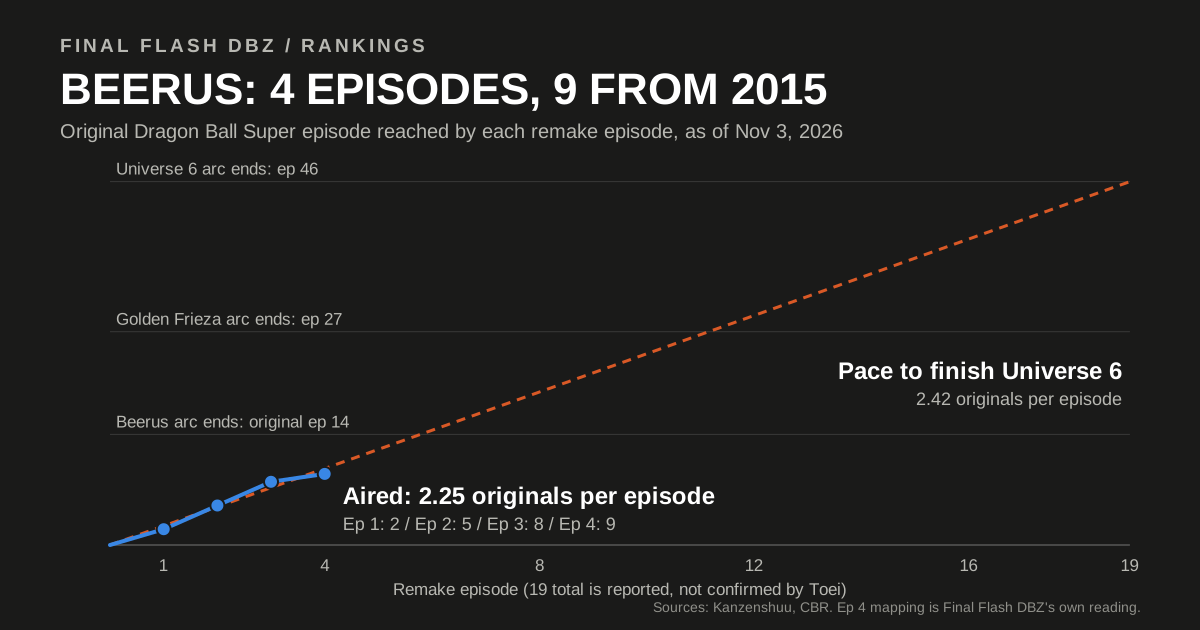
Here is the pace, using Kanzenshuu's mapping for the premiere and CBR's comparisons after it. Episode 1 covers original episodes 1 and 2. Episode 2 runs through the end of original episode 5. Episode 3 reaches original episode 8. Episode 4 stops at the Super Saiyan God birth, which is original episode 9, and that is our own mapping based on the 2015 episode title. Nine original episodes in four weeks works out to 2.25 per episode.
The total is the shakier number. Screen Rant and GameRant both state 19 episodes flatly, but Primetimer's September 28 report noted Toei had not confirmed that figure, ComicBook.com called the count unconfirmed on October 12, and Kanzenshuu's guide still says TBD. Take 19 as a working assumption. If it holds, and if the run really does finish the original's first three arcs at episode 46, the show has to average 2.42 originals per episode overall and 2.47 from here on. So episode 4, which advanced the story by only about one original episode, already has to be paid back.
Our projection, and it is only that: split 19 episodes in proportion to the original arcs (14, 13, and 19 episodes) and you get about six for Beerus, five or six for Golden Frieza, and eight for Universe 6. That would end the Beerus fight around November 15 and start Universe 6 around the end of December, assuming no holiday pre-emptions. Weekly airing with no breaks would put a 19th episode on February 14, 2027. That also fits the slot's other tenant: Beerus is borrowing One Piece's Sunday night home, and ANN reports One Piece returns sometime in 2027 with no date yet.
Why Beerus Cuts More Than It Rewrites
We owe a correction here. In September we repeated a report that the remake included "newly recorded dialogue." It does not, at least not as a rule. Beerus voice actor Koichi Yamadera said in an interview on the official site that the cast would not be recording, and Kanzenshuu's reading is that the original recordings are largely being reused. The Japanese announcement's phrase, as printed by AV Watch, is new "dubbing" with added score and sound effects, which we read as a new audio mix and not new performances. That is why late cast members still appear: Animehunch, citing Livedoor News and Animate Times, lists Joji Yanami, Unsho Ishizuka, Hiromi Tsuru, and Kozo Shioya. ComicBook.com cautions that Yamadera may only be speaking for himself, and there is one clear exception: Kanzenshuu reports Ryota Suzuki newly recorded Yamcha for episode 3.
This matters more than it sounds, and here is our inference: a remake working mostly from 2015 audio can remove lines far more easily than it can write new ones. That one constraint explains a lot of what fans are noticing. Kanzenshuu's episode 2 thread has posters flagging quiet stretches where nothing was re-recorded. CBR reports that Goku's much-criticized arrival on Earth keeps its dialogue but loses its music, with only a sound effect underneath. "Story reconstruction" in practice mostly means subtraction, plus new animation laid over the old voices. Kanzenshuu measured four removed stretches from the first two 2015 episodes alone at 17 minutes and 17 seconds.
The Ten Biggest Changes, Ranked Best to Worst
How we graded: this is a ranking of editing decisions as documented by Kanzenshuu's episode guide and threads, CBR's comparison pieces, and ANN's reviewers, not a shot-by-shot review. The test for each one is simple. Does the change make the Beerus story work better than the 2015 run did, and did it cost anything the arc needed?
1. Beerus wakes up in the first episode. Kanzenshuu documents newly animated awakening scenes, including Whis watching the awakening bombs go off, taken from the Battle of Gods film and absent from both the 2015 TV series and the manga. This is the best change because it fixes the original's biggest structural problem: the villain now arrives before the slice-of-life does. Bolts at ANN came away feeling Beerus had more menace, and that is exactly what the arc needs.
2. Goku stops calling Super Saiyan 3 his strongest form. Per CBR, the original line has Goku declaring it his most powerful, while the new version just promises to show Super Saiyan 3. Beerus's follow-up leaves the door ajar for something more. CBR itself concedes this does not establish Super Saiyan 4 from Daima as canon here, and we agree. But it removes a continuity headache for the price of one line.
3. The King Kai fight gets rebuilt. CBR called the 2015 version "laughably poorly animated." The new one adds fresh cuts and stretches the Super Saiyan 3 charge from about 20 seconds to almost a minute, with lightning running down Snake Way. This is the rare spot where the remake spends time instead of saving it, and it spends it on the right scene. Posters on Kanzenshuu note the fight still has no real tension, which is fair, since Beerus was never in danger in any version.
4. Goku's image training finally gets animated. Kanzenshuu notes the training against Frieza, Cell, and Majin Buu comes from the manga and was skipped by the 2015 anime. It costs almost nothing and turns a farm chore scene into a statement of what Goku cares about.
5. The slice-of-life purge, and the flashback that rescues it. Gone from the opening: Mr. Satan's press meeting (2:46), Goten and Trunks's gift hunt (6:28), and Vegeta's resort trip (7:12), all timed by Kanzenshuu. Bolts misses some of that humor, and so will a lot of 2015 fans. But CBR reports the family trip returns as a flashback in episode 4, which keeps the point about Vegeta the family man without the padding. That is the model for this whole project.
6. The pudding scene turns into horror. Buu still licks the entire tray, but CBR says Beerus's reaction now plays as a threat more than a gag. It is a risk, because this is the best joke in the arc. We rank it mid-table and above water because the stakes of the scene improve even if the laugh shrinks.
7. Oolong's rock-paper-scissors gets longer. New animation and a bigger share of the episode. Charles Hartford at But Why Tho? calls it slightly long but justified, while CBR says it overstays. Our problem is the choice itself: a remake that cut so much of its comedy spent its extra minutes on this one.
8. The Pilaf Gang gets cut in half. Dropping nearly all of original episode 4 was correct, since CBR's point stands that its main job was revealing Bulma had the Dragon Balls. Keeping them for about two minutes on the yacht is the mistake. They are now a question with no answer, and CBR argues they should have gone entirely. A half cut is worse than either a whole cut or no cut.
9. Bulma gets pushed instead of hit. According to CBR, Beerus now shoves her, and she shakes him instead of slapping him. The power scaling is more honest, but the scene exists for one reason: to set Vegeta off. Original episode 7 is literally titled "How Dare You Hit My Bulma!" When the insult becomes closer to an accident, the most famous Vegeta moment of the arc loses its trigger.
10. Vegeta stops cooking for Beerus. The worst change so far, and we land where CBR and many Kanzenshuu posters do. The cooking scene is dropped, and posters report the bingo dance went with it. Those scenes were silly, but the silliness was the point: the proudest character in the series humiliating himself to protect his planet and family, which is the payoff of everything in Vegeta's long arc. CBR also argues it is what pushes Goku to accept Super Saiyan God. A darker tone is not worth losing the scene that shows how far he has come.
The Pattern, and What to Watch
Look at the top and bottom of that list and a rule appears. The best changes import something from a stronger version of the story, whether that is the 2013 film or Toyotarou's manga. The worst ones remove comedy that was doing character work. That is why this remake reviews so unevenly: ANN's Jairus Taylor calls it a waste of time, Bolts sees one of the best ways for new fans to enjoy the story, and CBR gave its verdict in a headline, calling the first four episodes officially inferior to Battle of Gods. Every one of those can be true, because each is measuring a different thing.
Our advice: if you only want the best telling of the Beerus story, the 85-minute film is still it, and our rewatch guide explains why we put it first. If you are new and want a weekly path through early Super, the remake is a reasonable on-ramp, and it would replace the opening stretch of the 2015 run in the watch order if the reported scope holds. Fans who know the film should treat the Beerus arc as a warm-up.
What Happens Next
In our premiere date post we guessed 26 to 40 episodes and said the real test would come around episode ten, when the film material ran out. If 19 is right, we were too generous on both counts: the film material could be gone by episode 6, and Golden Frieza would arrive weeks earlier than we expected. Frieza is a stronger stress test than it looks, because his menace depends on patience, and patience is the one thing a 2.4-episode pace cannot afford.
The verdict on the whole project still rests on Universe 6, the first arc with no film to fall back on. That is where "story reconstruction" has to mean more than deletion. Watch for one thing as it approaches: whether the new-animation budget goes to the fights, as it has so far, or whether anything gets rebuilt in the slow middle of a tournament arc. If the show can fix that stretch, it will have earned its existence. Episode 5, listed for November 8, is named for the fight everyone came for. Everything after it is the part that decides whether this was worth doing.